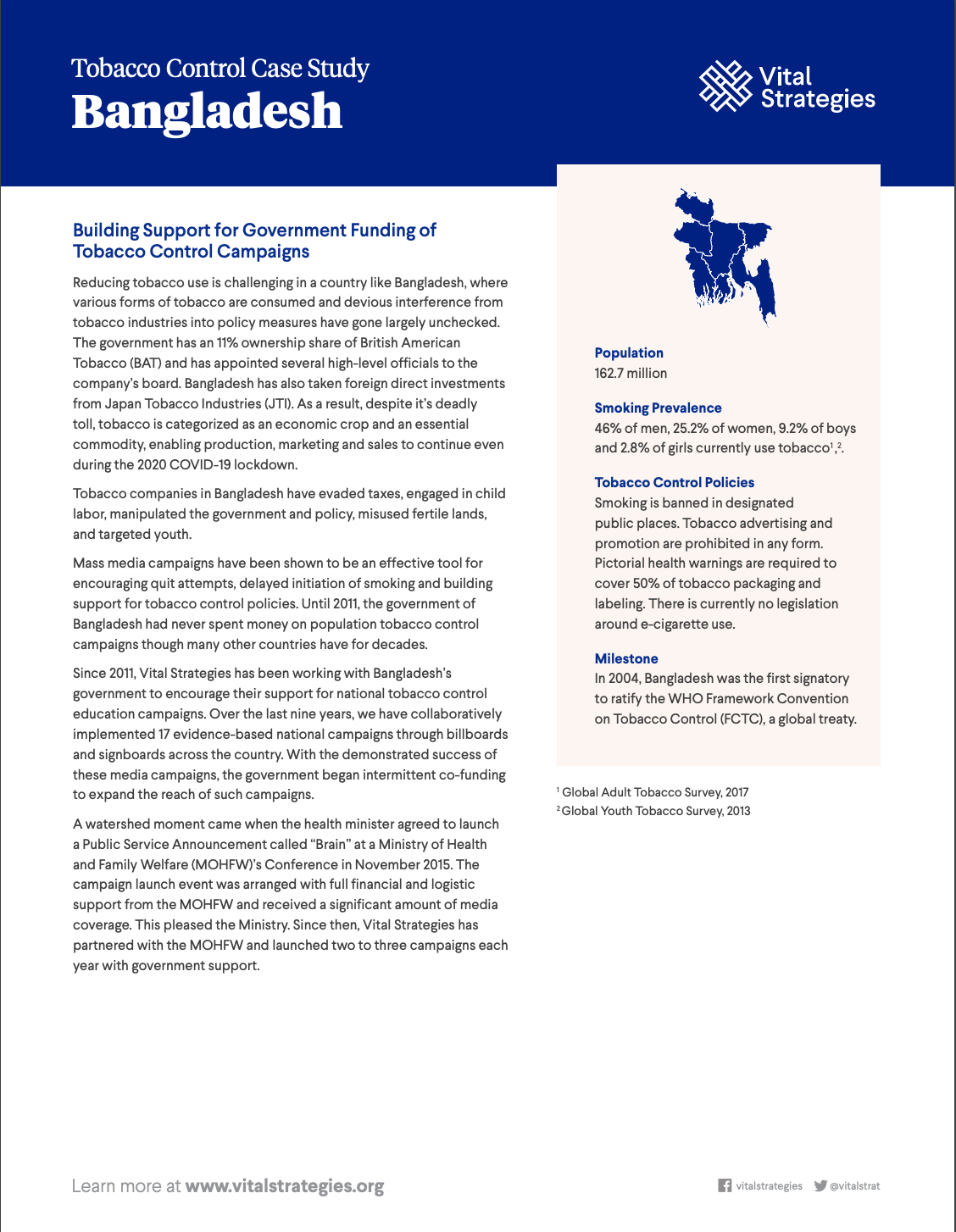
Reducing tobacco use is challenging in a country like Bangladesh, where various forms of tobacco are consumed and devious interference from tobacco industries into policy measures have gone largely unchecked. The government has an 11% ownership share of British American Tobacco (BAT) and has appointed several high-level officials to the company’s board. Bangladesh has also taken foreign direct investments from Japan Tobacco Industries (JTI). As a result, despite it’s deadly toll, tobacco is categorized as an economic crop and an essential commodity, enabling production, marketing and sales to continue even during the 2020 COVID-19 lockdown.
Mass media campaigns have been shown to be an effective tool for encouraging quit attempts, delayed initiation of smoking and building support for tobacco control policies. Since 2011, Vital Strategies has been working with Bangladesh’s government to encourage their support for national tobacco control education campaigns.
Recent Abstracts
Catalyzing Support for CRVS Improvement – Examples from the Data for Health Initiative
A Guide to Designing Contextualized Civil Registration and Vital Statistics E-Learning Courses
Guide to Developing Standard Operating Procedures (SOPs) for Civil Registration Using a Case-Based…
Building Safe and Healthy Communities
Uncovering the Hidden Risks of PM 2.5 Exposure Among School-Aged Children in Jakarta
Foundations & Futures: Reimagining Public Health in the Artificial Intelligence Era
Strengthening Health Systems to Address Air Pollution in Ethiopia
Policy Brief: Childhood Blood Lead Surveillance in Indonesia – Findings and Policy Recommendations
Impact of Blue Lanes on Road Safety: Crashes, Speed and Motorcyclists’ Perceptions in…
Impacto da Faixa Azul na Segurança Viária: Sinistros, velocidade e percepções de motociclistas…